Refrigerator Repair
121 Degrees at Pierce College: Ambient Temperature Limits, Garage Refrigerators and Ice Production in Woodland Hills
The Woodland Hills station at Pierce College reached 121°F in September 2020, and refrigeration kept above its rated ambient fails in a set order: ice production first, then freezer drift, then the condenser fan motor, then the sealed system.
Written byElena Sandoval
- Role
- Refrigeration technician — cabinet, door and seal work
- In the trade
- 24 years in the trade
- Certification
- EPA 608 certified
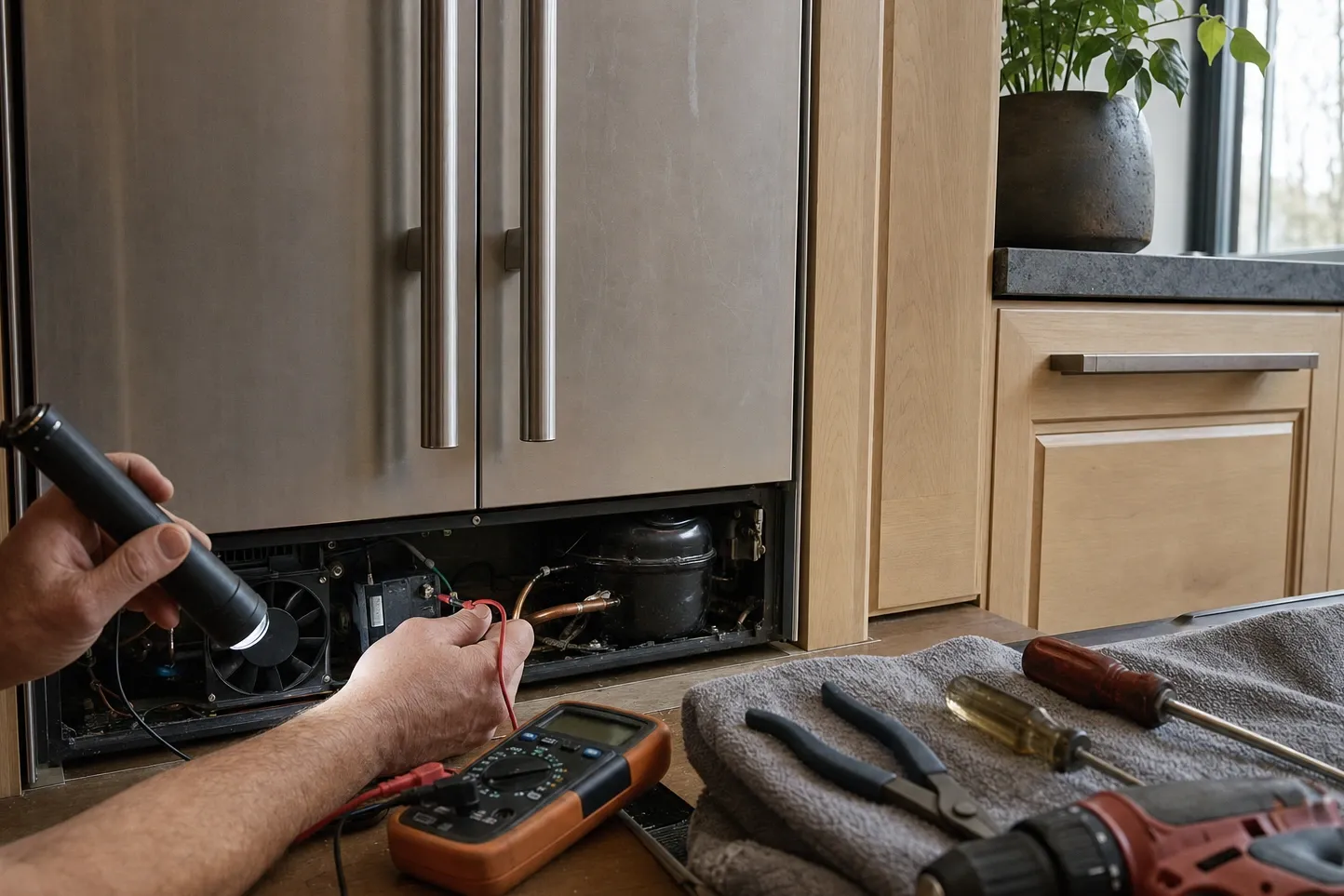
On 6 September 2020 the official weather station for Woodland Hills, at Pierce College, recorded 121°F. That is the highest temperature ever officially logged in Los Angeles County, two degrees above the previous mark from 2006, and it holds the record for Ventura, Santa Barbara and San Luis Obispo Counties as well.
For most people that number is trivia. For anyone with refrigeration standing outside the air-conditioned envelope of the house — in a garage, a butler’s pantry, a poolhouse or an outdoor kitchen — it is a service forecast. Built-in refrigeration carries a rated room-ambient window in its specification. Below the top of that window the machine behaves. Above it, the physics stop cooperating in a specific and repeatable order.
This is the sharpest internal split on our map. A Woodland Hills call in early September and a Venice call the same afternoon are two different jobs, because the machines are living in two different climates a half-hour apart.
The part of the year that matters
The season that drives west Valley refrigeration work is not the whole summer. It is the handful of inland heat episodes, often late in the season, when the air stalls and the afternoon runs deep into triple figures. The 121°F reading at Pierce College is the extreme edge of that pattern, not a separate phenomenon.
Those are the days when placement stops being a design choice and becomes a load. A garage in Woodland Hills on an afternoon like that is not room temperature and has never pretended to be. Neither is a poolhouse with a west-facing door, nor an outdoor run where the sun reaches the grille.
Westwood, Venice and Playa Vista sit under a marine influence and rarely generate this failure profile at all. A Playa Vista undercounter unit in an island and a Westwood column in a tower kitchen fail for other reasons entirely. That is worth saying plainly, because owners in the Valley are often told their appliance is defective when what it is actually doing is working exactly as designed in conditions outside the design.
What the swing asks of the machine
A refrigeration circuit gets rid of heat by condensing refrigerant at a temperature above the air around the condenser. Raise that air and the condensing temperature has to rise with it. Head pressure climbs, the compressor pumps against a wider pressure difference, capacity per cycle falls, and run time stretches until there is effectively no off period left.
Everything downstream of that is arithmetic. A compressor with no rest has no thermal recovery. A condenser fan that was designed for intermittent duty runs continuously. Dust that would ordinarily be a nuisance becomes an insulating blanket on a coil that now has no margin at all. And the cabinet itself is being asked to hold a set point against a temperature difference far larger than the one the door seals and insulation were drawn for.
None of that produces a fault code on day one. It produces wear, and the wear shows up in a sequence.
The failure it produces, and when
Ice goes first. It is the earliest and most reliable warning, because the freezing step has the least thermal headroom in the whole machine: cubes come out thin, hollow or slow to harvest, and output falls away exactly when the household wants more of it. Then freezer temperature starts drifting upward on the hottest afternoons and recovering overnight.
After that the parts start going. The condenser fan motor is usually the first casualty of continuous duty, at $310 to $680 here. The compressor and sealed system are the last and by far the most serious, at $1,300 to $3,030.
Wine storage shows the strain earliest of anything, because it has the narrowest band to hold and the least tolerance for drift. When a wine unit in a hot space cannot keep its band, the customer almost always reads it as a control fault and asks for a board. A control board is $440 to $970, and replacing one because the room is too hot changes nothing at all.
Getting ahead of it
Three things decide whether a unit in a hot space survives an inland September, and none of them is a part: where it stands, whether its air path is clear, and how often the condenser is actually cleaned.
Check the ambient rating printed for your model before you decide a garage or an outdoor run is acceptable — that figure exists precisely so the decision can be made on paper rather than in a heatwave. Give the grille genuine clearance and never let cabinetry, stored boxes or a laundry appliance sit in the discharge. Shorten the coil-cleaning interval for any unit in a garage, because garage air carries far more dust than kitchen air and the coil is the only heat exchanger you can maintain yourself.
Door seals matter more here too. A seal that is merely tired is invisible in a cool kitchen and expensive in a hot garage, where every leak is fought against a much bigger temperature difference. Gasket work runs $300 to $630.
What we do on the visit
We measure the room before we measure the machine. Ambient at the grille inlet, then the condenser’s actual condition, then the seal, then running readings taken while the unit is loaded rather than after it has been rested. That order exists so that nothing gets replaced to solve a problem the room is causing.
If the numbers say the machine is sound and the location is not, you will be told that, and the recommendation will be about placement, clearance and cleaning intervals rather than parts. If a component has genuinely been worn out by continuous duty, you get the part named and the figure before any tool comes out.
The visit itself is a flat $89 across Woodland Hills, Westwood, Venice and Playa Vista, and it covers the drive and the whole diagnosis. LA Sub-Zero Repair Pros can be reached on (310) 919-2538.
Follow-up questions
Can I keep a Sub-Zero in a Woodland Hills garage?
You can, provided the model's rated ambient window covers what that garage actually reaches on an inland September afternoon — Pierce College recorded 121°F in 2020. Give the top-front grille genuine clearance, keep the discharge path clear of stored boxes, and clean the condenser far more often than you would in a kitchen. Placement and airflow do more here than any part will.
Why did the ice stop while the food stayed cold?
Because freezing is the step with the least thermal headroom in the machine. When ambient rises and the circuit loses capacity, ice output is the first thing to give — thin, hollow or slow-harvesting cubes — while the cabinet can still hold food temperature. Treat it as an early warning rather than an ice fault, and act before freezer temperature starts drifting as well.
My Venice unit never does this. Why does the Valley one struggle?
Two climates on one service map. Venice, Playa Vista and Westwood sit under a marine influence and rarely generate heat-driven failures, while the west end of the Valley sees the inland extremes. The appliances are identical; the air they have to reject heat into is not. That is why a Woodland Hills call is usually about ambient and airflow and a coastal call is not.